
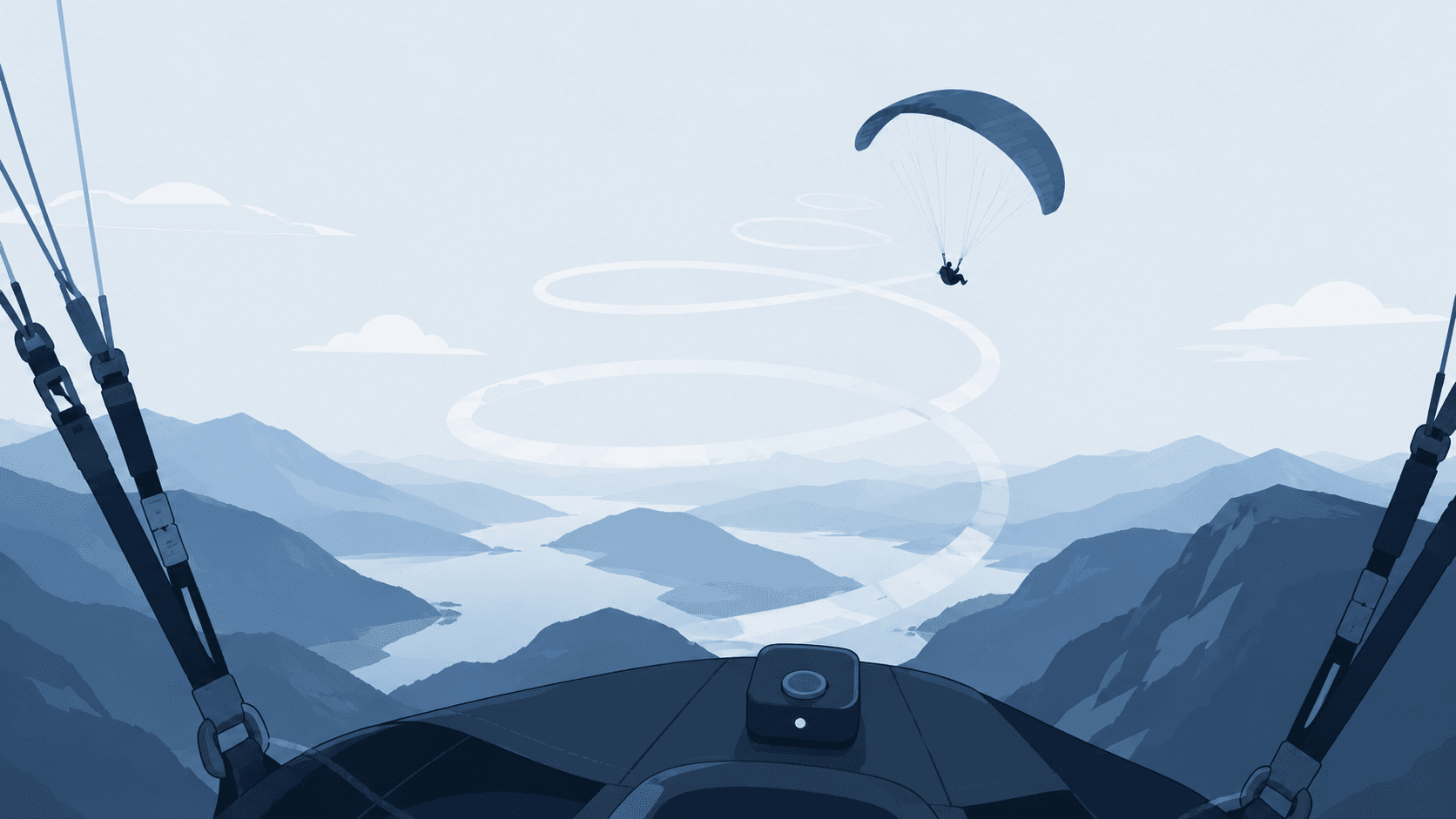
Understanding Basic Weather Principles
The sun does not heat every part of the ground equally. A dark field, a rocky slope, or a town can warm more quickly than the area around it. The air above that warmer surface heats up, becomes less dense, and starts to rise. Pilots call a usable column of rising air a thermal.
A paraglider is always descending through the surrounding air, but if that air rises faster than the glider sinks, the pilot climbs relative to the ground. Finding and staying inside this lift makes longer flights possible without an engine.
A variometer tells the pilot whether the surrounding air is helping the glider climb or making it descend faster.
How does the Variometer measure lift/sink?
Air pressure becomes lower as altitude increases. A variometer measures that pressure repeatedly with a very sensitive barometric sensor. When pressure falls, the device can infer that it is moving upward. When pressure rises, it can infer that it is moving downward.
In practice, the atmosphere is noisy and a pilot is constantly moving. Modern instruments therefore filter the pressure signal and may combine it with motion sensors. The aim is to estimate vertical speed quickly without turning every tiny disturbance into a false indication.
The result is normally shown in metres per second. A value of +1.0 m/s means the pilot is gaining about one metre of altitude each second. A negative value means altitude is being lost.
Where Pilot Meets Variometer
A pilot needs to keep looking outside, so sound is more useful than watching a screen. Short, higher, or faster tones usually indicate stronger climb. A lower or continuous tone can indicate sink. The exact sound pattern depends on the instrument and the pilot's settings.
The variometer reports how quickly the pilot is climbing or sinking at each moment. It cannot tell whether stronger lift is to the left or right, and it does not detect which side of the wing is in stronger lift.
To find the core, the pilot circles and listens for where the tone indicates the strongest climb during each turn. The pilot then shifts the next circle toward that area and repeats the process, gradually refining the path around the strongest rising air.